Predatory bugs
Beneficial bugs for crops protection
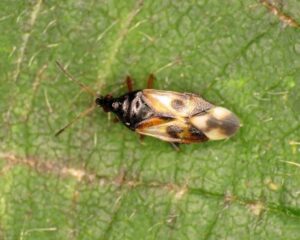
Bugs are an ancient suborder of insects whose history goes back to the Triassic period (approximately 250 million years BC). There are about 40 thousand species of 50 families. Among most people, the insects of this order have a bad reputation, which is associated with the usual association for many that, if a bug, then a “stinker”. And yes, indeed, most bugs have glands that produce an unpleasant odour based on aldehyde compounds. It is believed that this ability helps to scare off potentially dangerous enemies, and can also perform a pheromone function. There is also an opinion that bugs carry a danger to humans in their person, being a blood-sucker. In defence of the detachment, we can say that among 40 thousand species, only a few species of the Bed bug family (Cimex) regard this as a nutritional base. Among the representatives of bugs, there are also phytophages that harm plants and reduce yields. But there is a silver lining. Predatory mites of the genera: Macrolophus pygmaeus, Orius laevigatus, Orius majuscules, Orius niger, Anthocoris nemoralis, Nesidiocoris tenuis are of invaluable benefit to agriculture.
Useful predatory bugs
The benefit of predatory bugs is that by their nature they are entomoacariphages. An entomophage feeds on insects. An acariphage feeds on mites. An entomoacariphage feeds on both mites and insects, due to which it has a very wide range of effects. Predatory bugs include species whose individuals are capable of destroying more than one individual of the pest.
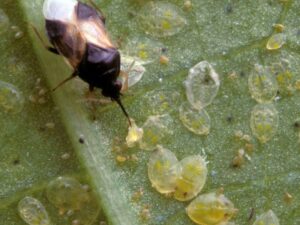
These bugs have proven themselves well as assistants in the fight against parasites in different cultures. They feel great on pepper, eggplant, tomato, strawberry and even certain decorative species. They controls populations of various species of thrips, whitefly at all stages of development, tomato mining moth, aphids, spider mite. Predatory bugs are effective against Agrotis eggs. Some species feed on pear psyllid and are even acclimatised to open ground conditions. With a lack of food supply, bugs switch to feeding on the nectar of the plant to some extent, even indirectly performing a pollinating function.
Now the biological method is increasingly used to protect plants from pests. With a competent approach, predatory bugs will serve as a “natural insecticide” in the greenhouse, allowing you to grow a healthy crop without a drop of chemistry.
Popular types of predatory bugs
The most famous representatives of predatory bugs:
Macrolophus pygmaeus
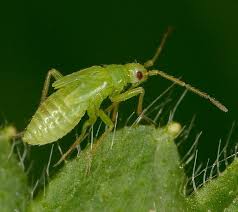
Macrolophus pygmaeus is one of the most famous representatives of its species. He can confidently be called a “star” who has won the hearts of many agronomists and greenhouse workers. It is a small, approximately 0.5 cm green bug with a very wide spectrum of pest damage. This little one copes with the control of populations of whiteflies, mites, aphids, tomato miners and thrips. A versatile soldier in greenhouse conditions, making life easier and increasing yields.
Orius laevigatus
Orius laevigatus is a bug slightly smaller than Macrolophus. The dimensions are 2.5 — 3 mm, the body is dark in colour. It promotes a secretive lifestyle. This species is very effective in the fight against thrips. The diligence and diligence of this insect allows you to find prey in the most inaccessible areas like flowers and leaf covers.
Orius majusculus
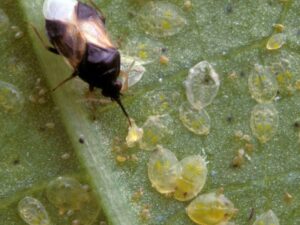
Orius majusculus looks similar to Levigatus, it also has a dark brown body colour and dimensions of 2,5-3 mm. In addition to effectively fighting thrips, it copes well with aphids and spider mites. It is very effective on ornamental crops. Prefers to hunt in the dark.
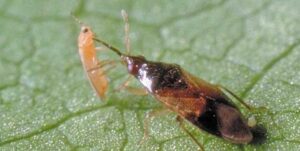
Orius niger
Orius niger also has a dark colour, but among Orius the smallest and completely black. Its length is about 2 mm. But, little strokes fell great oaks. Despite its tiny size, Orius niger is a formidable rival for the western flower thrips and spider mite. In addition to effective control of thrips and mites, it consume aphids along the way.
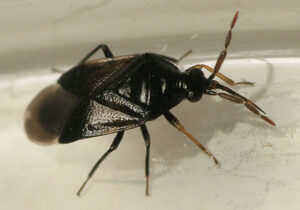
Anthocoris nemoralis
Anthocoris nemoralis is a small bug about 3 mm long, dark in colour with white markings on the wings. In addition to the standard set of natural victims, such as aphids and spider mites, this species has proven itself well in the fight against pear psyllid. One of the distinctive features of the individual is good acclimatisation in the open ground.
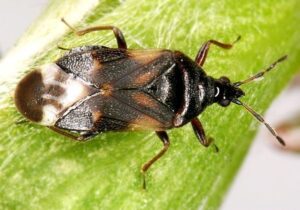
Nesidiocoris tenuis
Nesidiocoris tenuis is a predatory bug, similar in size and appearance to Macrolophus. A distinctive feature is the darker wings on the back with pronounced dark spots. Consume whiteflies, Tuta absoluta, aphids, spider mites, and scoop eggs. Nesidiocoris feeds on whitefly individuals at all stages of development. It is recommended to use this type of predatory bug only in case of a massive invasion of pests. This is due to the fact that Nesidiocoris also feeds on plant juices and, with a lack of forage, will begin to feed on plants, causing them damage similar to that caused by pests.
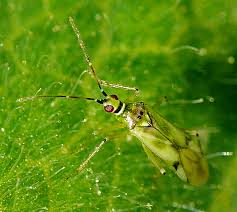
Conclusion
Predatory bugs have proven themselves to be an eco-friendly method of fighting dangerous pests. Thanks to this, biomethod is becoming an increasingly popular way of protecting plants every year.