Aphids
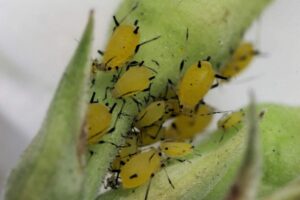
Aphids are tiny insects up to 5 mm long, in rare cases more. At its core, phytophages, that is, organisms that feed on plants. But despite their small size, they pose a great threat to plants. If you delve into entomology, then each species has winged and wingless forms. One form is responsible for reproduction, the other for distribution. They feed on the juices of plants, at the same time releasing the pad, in which various fungi and microorganisms are formed and multiply, which negatively affects the development of the plant. They multiply at an incredible rate. Within a month, about 3 generations may appear from one individual, which will number hundreds of thousands of representatives of the species. They are common in open and protected ground.
Danger of aphids
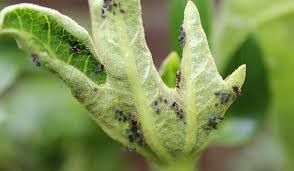
The danger of aphids also lies in the fact that drinking the juices of the plant, it provokes a decrease in fertility, and sometimes the death of the culture. One of the tricks of aphids is to fold the leaf of the plant. The aphid hides in its bends, which prevents it from being detected and destroyed.
Ants and aphids
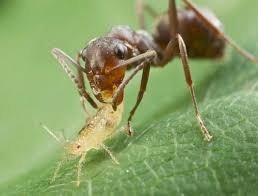
The main carriers of aphids are ants. Aphids secrete sweet honeydew, which attracts ants and is part of their diet. It turns out to be a kind of deal in the circle of insects. Aphids feed the ants, and the ants, in turn, provide transportation services, in some cases protection and shelter, taking them to the anthills for the winter. Therefore, in the fight against aphids, it is necessary to take into account the factor of ants.
Common species
Despite the fact that there are about 5 thousand species of aphids, 20% of which live in Europe, the most widespread and known to us are
- Gall aphid (Pemphigidae)
- Bean aphid (Aphis fabae)
- Melon aphid (Aphis gossypii)
- Cabbage aphid (Brevicoryne brassicae)
- Grape phylloxera (Dactylosphaera vitifoliae)
- Rose aphid (Macrosiphum rosae)
- Green apple aphid (Aphis pomi)
- Glasshouse-potato aphid (Aulacorthum solani)
- Green peach aphid (Myzus persicae)
Gall aphid (Pemphigidae)
Gall aphid is a big fan of currant bushes. It is called gallic because it causes pathological formations on the sheet called “galls». They are formed due to the fact that aphids suck out the juices of the plant, weakening it and provoking the creation of new tissues. With the inaction of the farmer, the growth of the aphid population simply destroys the plant.
Bean aphid (Aphis fabae)
Bean aphid, despite the name, is a polyphage, but has priorities in nutrition, as the name again indicates. Like other members of the family, it sucks the juices of plants and is a vector of beet diseases.
Melon aphid (Aphis gossypii)
Melon aphid is a pest for more than 300 plant species. They settle on the youngest leaves and shoots, destroying them in the process of vital activity. Favourite crops are cucumber and gourds.
Cabbage aphid (Brevicoryne brassicae)
It is a pest of cruciferous crops, settling on the lower part of a leaf, shoots or stem. Plants affected by aphids are suspended in growth, their leaves are deformed, twisted, acquiring the shape of a dome.
Grape phylloxera (Dactylosphaera vitifoliae)
European vineyards learned of its existence at the end of the 19th century, when it was brought from North America. A small insect, about 1 mm long, infected almost all the vineyards of France. It is still a dangerous pest, but since then there have been a lot of ways to deal with it.
Rose aphid (Macrosiphum rosae)
These aphids damage the aesthetic appearance of rose bushes, distorting flowers and foliage, as well as forming a smitey pad, which often provides a surface on which soot mould develops.
Green apple aphid (Aphis pomi)
It causes great harm to young gardens, mercilessly damaging fruit trees. Symptoms of an infected tree include twisted and withered leaves. Shoots are delayed in growth and covered with honeydew, and are subject to diseases.
Glasshouse-potato aphid (Aulacorthum solani)
It causes maximum damage to apricot, peach and tobacco trees. It devours potatoes, peppers, tomatoes, cabbage, eggplant, cucumber, watermelon, carrots, beets, sunflowers, cotton, radishes, cherries, apple trees, plums and many other plants. It has more than two hundred secondary hosts.
Aphid control
The fight against aphids is always difficult. The rapid cycle of development and high fertility of females, in a short time significantly increases the population of the colony. But considering that it is difficult to even come up with a culture that is not subject to aphid attack, it is simply necessary to defend yourself. As practice shows, the use of chemicals in the fight against this pest requires repeated repetition to solve the problem. As a result, it will be difficult to vouch for the quality of the crop and its benefits after its use.
Of the harmless ways, it is possible to note the natural enemies of aphids, ladybugs, ground beetles, predatory bugs. The following parasitic wasps are also very effective:
- Aphidius colemani;
- Aphidius ervi.