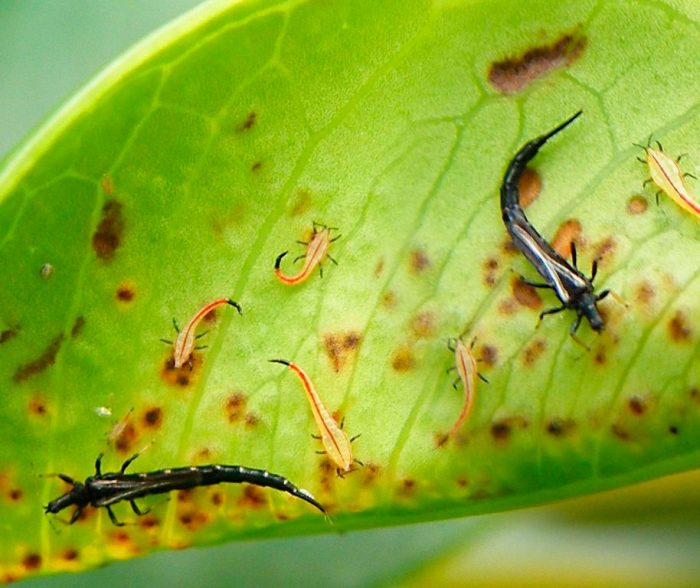
The entomological fauna has been enriched with a new insect — over the past few years, the western flower thrips (Frankliniella occidentalis) has spread throughout the territory, and plant protection specialists have a new concern — the fight against this currently perhaps the most dangerous plant pest in greenhouses.
Currently, thrips all over the world is becoming the most dangerous pests. The reasons for this are the peculiarities of biology and the increasing resistance of thrips to many modern pesticides. Thrips quite quickly acquires resistance to pesticides, which creates difficulties in the organization of chemical control and makes it necessary to improve methods of suppressing their numbers. To build effective plant protection, it is important to know the biology of the pest, namely:
Description of the pest.
Males up to 1 mm in length, females are slightly larger (up to 1.5 mm in length). Color varies from pale yellow to dark brown. The winged insect has two pairs of wings.
What crops thrips can damage?
Western Flower Thrips is a polyphagous species. It damages more than 200 plant species, including fruit plants, vegetables and flowers. Indoors, it is especially harmful to roses, chrysanthemums, gerberas, other flowers, cucumbers, eggplants, peppers, tomatoes, etc.
Pest biology.
It pierces plant cells with its mouthparts and sucks out the juice. Thus, empty plant cells form «silver spots» on the leaves. In case of serious damage, drying of plant shoots and falling leaves are possible. Flowers are very attractive to pests. In case of damage to unopened buds, flowers may not appear. Often in commercial floriculture, flowers become unmarketable due to damage by Western Flower Thrips.
Vegetable crops are damaged to no lesser extent. Most dangerous is the fact that Western Flower Thrips is a carrier of many plant viruses. Often the effects of damage are seen too late, as thrips damage the flowers, and the fruits appear much later, and deformations are visible on the fruits. Therefore, it is very important to keep the thrips population at a low level.
In favorable climatic conditions, it is able to give 12 — 15 generations per year. The female is fertile and is able to lay more than 50 eggs in average, approximately 1 to 2 eggs per day. The eggs are laid in the tissue of the leaf. Under favorable conditions, western flower thrips lays up to 200 eggs.
The development cycle of the pest consists of six stages — egg, first instar larva, second instar larva, pre-pupa, pupa and adult.
Thrips flies weakly, but is able to be carried by wind currents.
Additional Information.
It willingly feeds on the eggs of spider mites, due to which the population is growing rapidly. Studies have shown that Western Flower Thrips can also eat phytoseiid eggs. Yellow, white and blue colors are attractive to thrips, so sticky traps in these colors are an excellent tool for trapping adult thrips (adults).
Other aspects of harmfulness.
Given the specificity of the Western Flower Thrips to carry plant viruses, it is considered one of the most harmful insects in the World.