Entomophages
About the Entomophagy
Entomophagy is the phenomenon of eating insects (from the Greek entomon — insects and phagos — eater), inherent in many species, including humans. But we are not talking about the traditions of Thai or Cambodian cuisine, but about useful insects. From the above it becomes clear that insects entomophages are called insects that consume other insects (sorry for the tautology). In continuation of the topic, let’s look at some more terminology. In addition to entomophages, there are also acariphages, often considered the same, but this is not true and we must understand the differences. The entomophage feeds on insects, the acariphage feeds on mites. Why is there such a division? Everything is elementary, mites are not insects, but arachnids. For a general understanding of the topic, it is also necessary to understand the division of agents of the biological method of protection into predators and parasites.
Parasitoid entomophages
Parasitoid entomophages can be both similar to each other and radically different in appearance. They have in common that the larvae live at the expense of the internal organs of the host individual. Adult insects are characterised by the presence of wings and a free lifestyle, they feed on nectar, while producing indirect pollination. And of course, the hemolymph of insects, which the females extract by piercing the body of the pest with an ovipositor. The most common name for such entomophages is Ichneumonidae (Parasitic Wasp or Parasitoid Wasp). The name is characterised by an external similarity to wasp, but the main difference between is the absence of a sting, instead of which there is an ovipositor in its place.
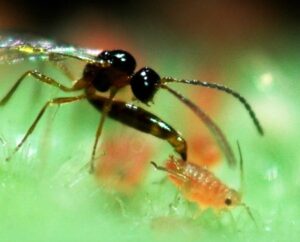
Another feature of the parasitoid wasps Is the way of parasitizing on the host. There are two types of entomophagous parasites — endoparasites and ectoparasites.
Endoparasites
Endoparasites lay eggs inside the host’s body and develop there. The host body can mean not only adults, but also larvae, as well as eggs. Parasitoid wasps parasitize in eggs are also called egg-eaters. Most Ichneumonidae are endoparasites.
Ectoparasites
Ectoparasites develop on the host body. Oviposition is performed on the host’s body, the parasitic wasp pre-paralyzes it and lays eggs, usually at the puncture site. There is also a strategy for laying eggs on the plant in the host’s feeding areas. The host insect swallows the eggs of the parasitoid wasps in the process of feeding the plant, after which the offspring of the entomophage develops in the intestines of the host.
Entomophages can be divided into monophages and polyphages. Monophages hunt only a certain species. Polyphages have a wide range of victims.
Among Ichneumonidae popular and effective agronomic species can be distinguished:
- Habrobracon hebetor
- Encarsia formosa
- Eretmocerus eremicus
- Aphidius ervi
- Aphidius colemani
- Diglyphus isaea
- Anagyrus pseudococci
Predatory entomophages
Predatory entomophages include insects at the larval and imago stages, whose prey and food becomes more than one individual of the species. Predators include various orders of insects and mites (among which there are many acariphages). There are also predators with a narrow specialisation — monophages, which prefer victims of a certain species. Polyphages, in turn, have a wide range of effects.
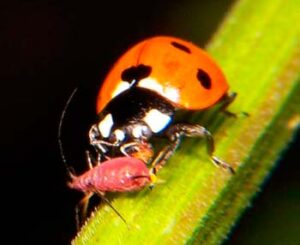
Among the predatory entomophages, popular and effective agronomic species can be distinguished:
- Amblyseius montdorensis
- Amblyseius swirskii
- Hypoaspis miles
- Macrolophus pygmaeus
- Delphastus catalinae
- Cryptolaemus montrouzieri
- Orius laevigatus
- Anthocoris nemoralis
Acariphages
Acariphages in the process of nutrition are similar to predatory entomophages, with the only difference that the food base is made up of mites.
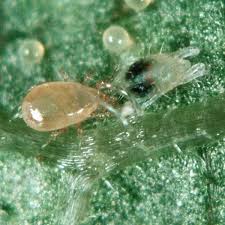
Among the acariphages, popular and effective agronomic species can be distinguished:
- Neoseiulus californicus
- Amblyseius andersoni
- Neoseiulus cucumeris
- Phytoseiulus persimilis
Conclusion
The use of entomophages as defenders of their greenhouses, conservatories or gardens is the most environmentally friendly method of fighting crop oppressors. Nature has already made sure that each pest has its own natural enemy controlling its population. Our business is to take advantage of this opportunity.
Of course, it is impossible to randomly introduce entomophages without conducting a preliminary analysis. To achieve your goals in any business, you need a plan and a system. First of all, it is necessary to understand who the enemy is, what culture lives on and the scope of the problem. After that, it is already possible to draw some conclusions and effectively attack the pest. But in any case, entomophages are the safest way to deal with the problem for nature, humans and your crop.